
Product Guides
What Size Turf Cleaner Do You Actually Need?
August 29, 2026 · David Schrimpf
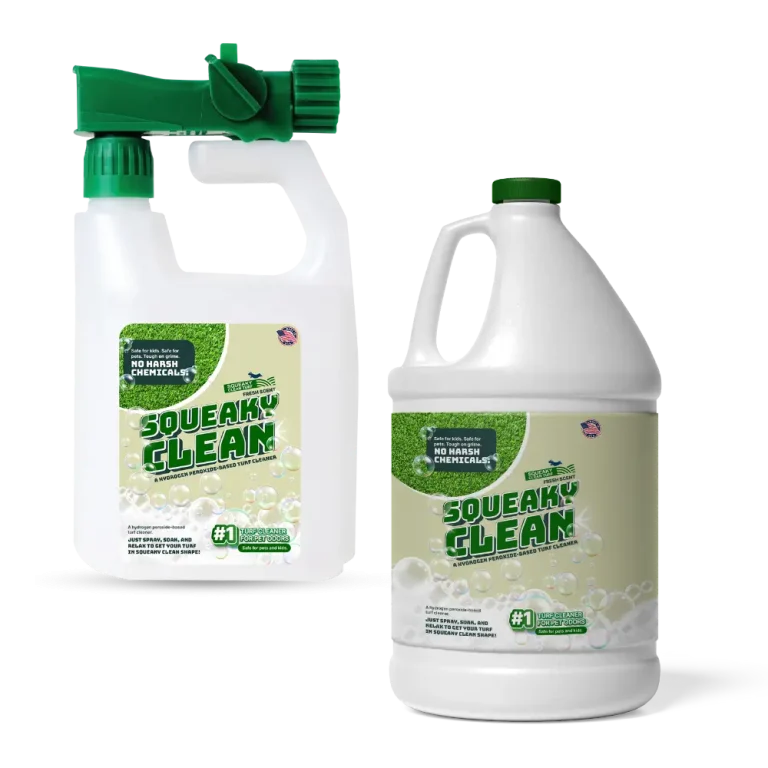
The question we field more than any other is not about how the formula works. It is: how much of it do I need? People buy a 32 oz sprayer for a 1,200 sq ft backyard, run out in one pass, and conclude the product is weak. The product was fine. The math was wrong.
Here is how to get it right the first time.
Start with square footage, not bottle size
Every size we sell is the same formula at full strength. Nothing is mixed, nothing is measured, and a gallon poured into a pump sprayer behaves exactly like a gallon poured into anything else. So the only real variable is how much turf you are covering, and how often.
If you do not know your square footage, you can get close enough in two minutes: pace the turf area heel-to-toe (most adult paces are about 2.5 feet), multiply length by width, and round up. For an irregular yard, break it into rectangles and add them together. Precision does not matter much here — you are choosing between a gallon and four gallons, not calibrating equipment.
The coverage numbers
- 32 oz hose-end sprayer — about 250 sq ft. A patio strip, a balcony, a putting green, or the one corner your dog has claimed.
- 1 gallon — about 1,000 sq ft. A typical Valley backyard, once.
- Starter kit (sprayer + gallon) — about 1,250 sq ft combined.
- 2 gallon pack — about 2,000 sq ft.
- 4 gallon case — about 4,000 sq ft, and it fills a standard backpack sprayer exactly.
- 55 gallon drum — about 55,000 sq ft.
- 275 and 330 gallon totes — about 275,000 and 330,000 sq ft.
Those are single-pass figures. Which brings us to the part most people skip.
Frequency matters more than yard size
A 600 sq ft yard with two large dogs will go through more product in a summer than a 2,000 sq ft yard with no pets at all. Square footage tells you how much one pass costs you. Pet load tells you how many passes you need.
Rough guide, based on what our own route looks like:
- No pets — two or three times a year is plenty. Dust and organic debris, nothing more.
- One dog — monthly through the warm months, less in winter.
- Two or more dogs, or a dedicated dog run — every two to three weeks from May through September, and you will notice if you skip.
Arizona summer is the multiplier. Heat drives odor back out of the turf backing, so the same yard that needed attention once in March will need it three times in July. Budget for the summer, not for the annual average.
Putting it together
Take a 1,200 sq ft backyard with two dogs. That is 1.2 gallons per pass, roughly every three weeks across a five-month summer — call it seven passes, or about eight to nine gallons to get through the season. Buying that as single gallons means seven separate orders. The 4 gallon case twice over is the same product at a lower cost per gallon and two deliveries instead of seven.
Now take a 400 sq ft side yard with one dog. That is well under half a gallon per pass. The starter kit will genuinely last most of a year, and the hose-end sprayer is the right applicator at that size — no pump, no tank, no setup.
When to stop buying jugs
There is a clear line where jugs stop making sense. If you are treating more than about 4,000 sq ft on a repeating schedule — a boarding facility, a sports field, an HOA with several common areas, or a landscape crew running turf care as a route — the 55 gallon drum changes the economics and the logistics at the same time. One drum refills a 4 gallon backpack sprayer roughly thirteen times.
Past that, the 275 gallon tote suits facilities with turf permanently on site, and the 330 gallon tote is what distributors and re-packers order, because it occupies the same single pallet as the 275 for fifty-five more gallons.
A note on the “buy the biggest size” instinct
It is usually right, but not always. The formula keeps well in a sealed container, so a 4 gallon case sitting in a garage is not a problem. A 55 gallon drum in that same garage is — it arrives by freight on a pallet, it needs a pump or a spigot to draw from, and you need somewhere to put it. Buy the largest size you can actually handle and store, which for most homeowners tops out at the 4 gallon case.
Where to buy
Everything is on our shop page, and the two most common household sizes are now listed on Amazon as well — the 32 oz hose-end sprayer and the 1 gallon refill — if that is where you would rather order. Same formula, same bottles.
If you are still not sure, tell us the square footage and how many dogs use the space and we will tell you what to buy. We would rather size it correctly once than sell you a bottle that runs out halfway across the yard.
Prefer we handle it? Our deep cleaning service covers the Phoenix valley, and you can get a quote in about a minute.
Where to go from here
Let a pro handle it
Squeaky Clean™ Formula
The same cleaner our crews use, for in-between care.
Learn More →Shop the Cleaner
Spray, jug and refill sizes for any yard.
Learn More →Pet Turf Cleaning
Dog urine odor pulled out of the backing, not masked.
Learn More →Pet Odor & Stain Removal
Targeted treatment for the spots your dog uses most.
Learn More →Squeaky Clean Turf is based in Mesa and cleans residential and commercial turf across Greater Phoenix, including Phoenix , Scottsdale , Mesa , Glendale , Gilbert , Chandler , Tempe and Queen Creek . See every area we serve.
From the blog
Keep reading
Artificial Turf
5 Things You Should Never Use to Clean Artificial Turf
Bleach, pressure washers, vinegar, solvents and hot water all damage synthetic grass. Here is why, and what to use on turf instead.
Read the guide →Turf Cleaning
How to Clean Artificial Turf With Dogs (DIY Guide)
A step-by-step routine for cleaning dog pee and poop off artificial turf at home, what to do daily, weekly and monthly, and when DIY stops working.
Read the guide →Turf Care
Why Artificial Turf Gets Crunchy and Matted (And How to Fix It)
Flat, stiff, or matted artificial turf is a common problem in Arizona — but it's usually fixable. Here's what causes it and how to bring your lawn back to life.
Read the guide →Ready for a Squeaky Clean Yard?
Get a free quote and we'll have you fresh in no time.
Get A Free Quote